ICTS in Rural China: Final Thoughts
The idea for this project arose out of discussions between myself and Tom McDonald, during the 2013 Chinese Internet Research Conference, about the nature of academic research outputs. Tom had just started ethnographic research in the town featured in this project as part of University College London's Why We Post project and I was in the first year of my DPhil at the Oxford Internet Institute. In our discussions, we both agreed that academic research could be doing lots more to engage audiences. With an estimated more than two million academic articles published per year, academics joke that it's futile to try to keep up with their reading, and this is to say nothing of policymakers, stakeholders and the general public.
Academic research has solidified into the agreement about how research should be presented: often in journal articles, with an abstract, then an introduction, a literature review, methods, findings, discussion and conclusion. The length of research articles differing between disciplines buy homogenous within disciplines. However, academic research wasn't always written, prior to global publishing oral presentations, such as teaching and lecturers, were much more important. Now in the age of the Internet, might academic research not look to new formats of presentation, rather than written word on printed paper?
The Why We Post project that Tom was part of was already forward thinking in this regard, with active social media feeds, and plans to hire photographers and videographers at each field site, 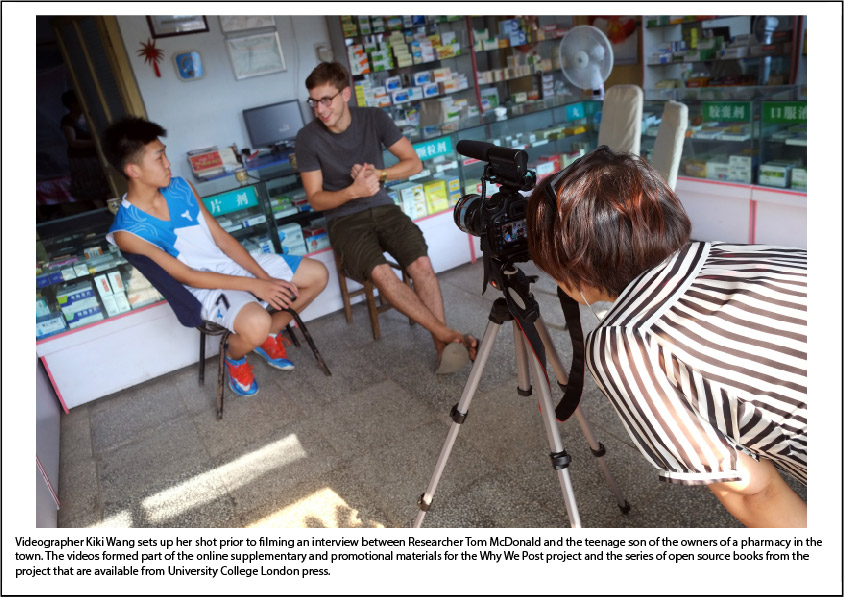 and publishing open access so that their publicly funded research would be available to all. Drawing on my previous career as a multimedia journalist, I told Tom during our discussion that I would love to come to his field site to take photographs for the project.
All the photos and videos presented on this website were taken during an eight-day period in the summer of 2014, 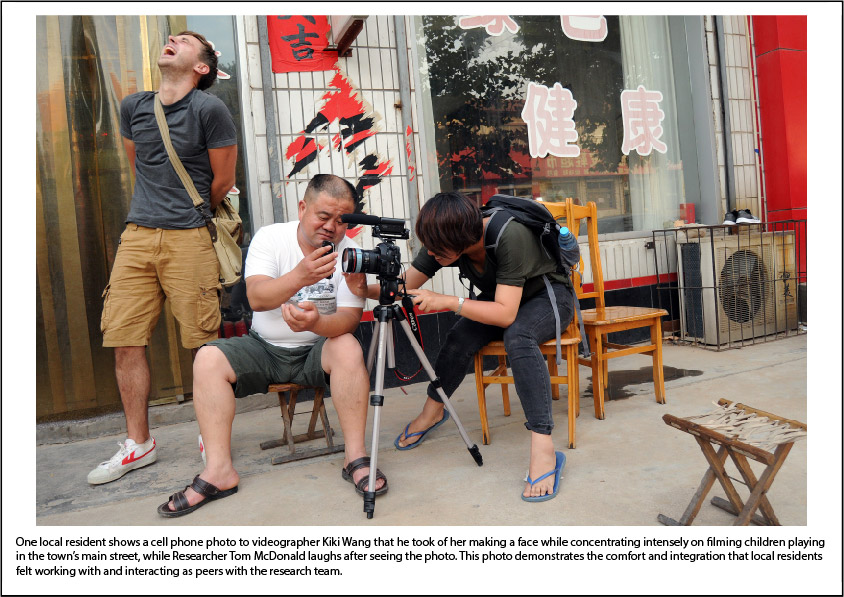 when both myself and Kiki Wang, a Beijing-based videographer, visited the town. At that point, Tom has been a regular presence in the town for a year and a half, conducting ethnographic research. Ethnography is a form of research, common in anthropology, in which the researcher embeds themselves in the place of study. Conducting ethnographic research requires long periods of time spent committed to the project, compared to other methods such as interviews or surveys; ethnography requires being there. This makes it a natural fit for experiments with visual methods because you can't take a photo from your office.
My aim was to use photography and visual methods as an iterative research methodology. This means that I used photography as part of my research process. Where an ethnographer would make notes, normally after the fact, of the relevant events that they experienced, I photographed these events and then later analyzed these photographs to unpick both what the event meant but also to understand the choices that I made as a researcher during the process of taking and composing a photo.
I wanted to use photography also to connect with the individuals I was researching, I printed out my photos every morning in a little shop in the town and brought them with me during my research, using them as prompts to elicit discussion with townspeople. I would ask them what they saw in the photo, explain why I took the photo and what I saw, and asked them if they agreed with my interpretation of what I saw. These photos enabled me to connect with people in the town in a way that wouldn't have been possible otherwise.
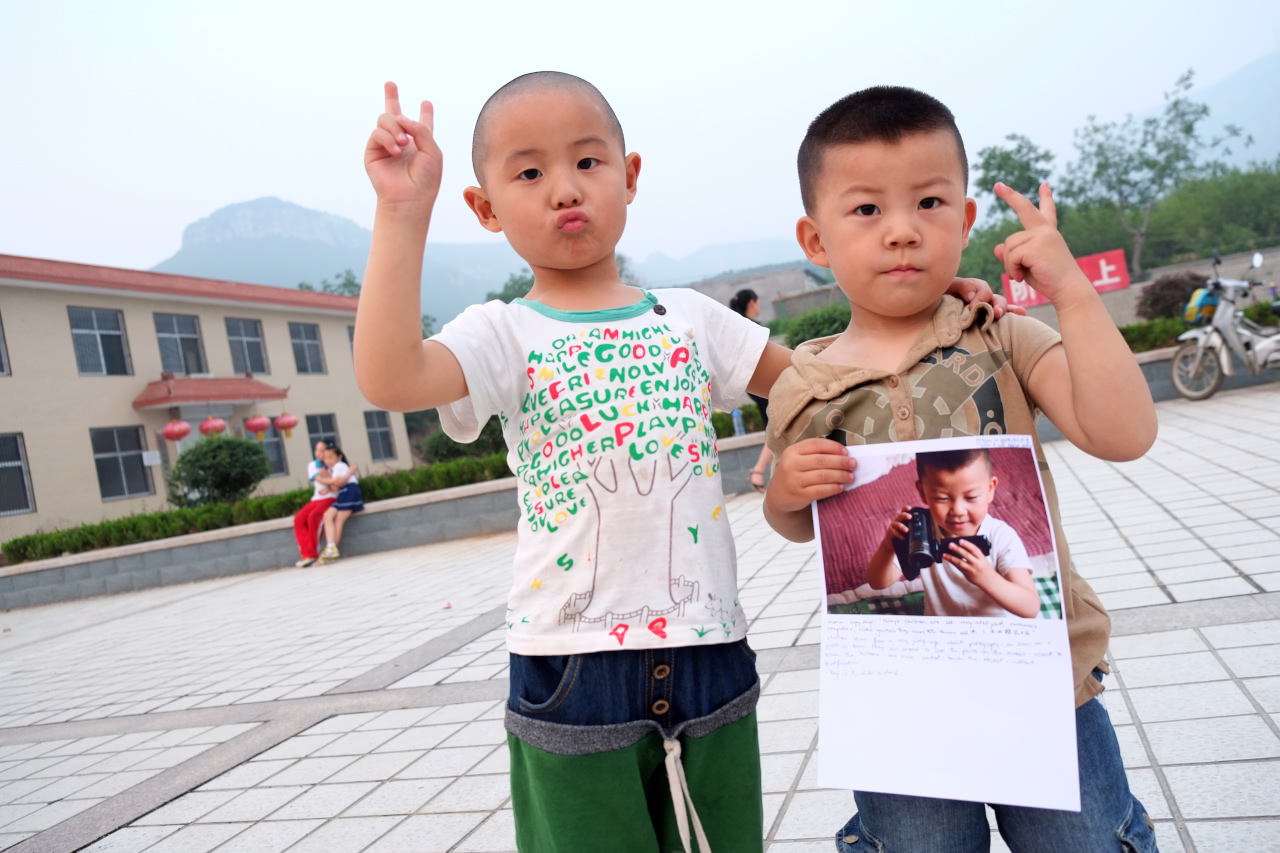
This main photo for this page illustrates the iterative nature of the method. Two boys pose for a photo in a park. One holds the printed photo that I took the previous day of him watching a video of himself on his parent's camera. There are notes on the printed photo 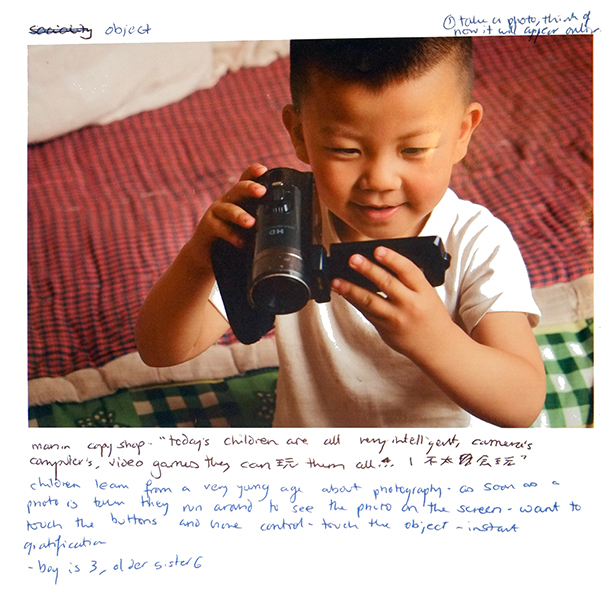 from my discussions with townspeople about the photo. I later printed out this photo and gave it to the parents of these children as a thank you gift.
However, the iterative nature of photography as this research method shouldn't stop there. The photos I took during my time in the town are presented throughout this site, along with my spoken and written words about what I saw in the photo. Each section has a commentary video in which both Tom and I reflect on our answers to the research questions posed, but each page also has a space for users to leave comments, which will, after moderation, be included as part of this site. In this way, rather than having a final conclusion that is written, printed and finished, it is hoped that, through the medium of photography, the conversation about the impact of ICTs on everyday life can continue as this phenomenon continues to grow and evolve.