Comment: What is the role of photography as a form of social communication?
This project has been nearly six years in the making. Started as an experimental side-project to my doctoral research, progress was made only in short busts, separated by long periods of dormancy. The whole project almost died during my yearlong position as a postdoctoral researcher and then the six-month period that I spent after applying to academic positions, and it was only once I found the relatively stability of a permanent academic job at the University of Leeds that I had time to really bring this project to completion.
In the time since the project fieldwork was undertaken in the Summer of 2014, China has changed a great deal. Xi Jinping, who became China's paramount leader in November 2012, has reversed the gradual liberalization that characterized the previous two decades, under leaders Jiang Zemin and Hu Jintao. There has been, under Xi Jinping, an aggressive crackdown on endemic corruption; a more aggressive foreign policy toward Japan, Taiwan and the South-China Sea; a tightening of the spaces for freer political speech and activism that had previously seemed to be opening in areas like human rights, environmentalism and within higher education; there's increasing repression of the Uighur minority group in the far north-western province of Xinjiang; and the rolling out of a comprehensive social credit system that will draw from all available data to give citizens scores that will affect all aspects of their lives from what jobs are available to them to whether they can buy domestic high-speed train tickets or fast broadband packages.
At the same time as these political changes, China's technological connectivity has proceeded apace. Rural internet connectivity has continued to rise, from about 30% in 2014[1] (when this fieldwork was undertaken) to 38% in the summer of 2018[2]. Online purchasing has continued to grow: China is, by far, the world's largest online commerce market and in last November 11 Singles Day sales retail giant Alibaba topped US$30 billion in sales[3]. At the same time, the number of Taobao villages, rural areas with a total annual e-commerce transaction volume of at least RMB 10 million and at least 100 active online shops, have increased from just 20 in 2014 to more than 3000 in 2018[4], and mobile wallet payments are now the norm with some small shops in large cities no longer handling cash and customers paying for their goods and services by scanning a QR code on their phone to transfer money from one of their main mobile payment services to the vendor[5].
Technological synergy and the potential for surveillance has multiplied in the time since this research project was first started. AI, previously developed for policing in Xinjiang, has been rolled out across China, and the police use facial recognition technology to pick out wanted individuals from crowds [6] and there's automated ID card scanning and facial recognition gates 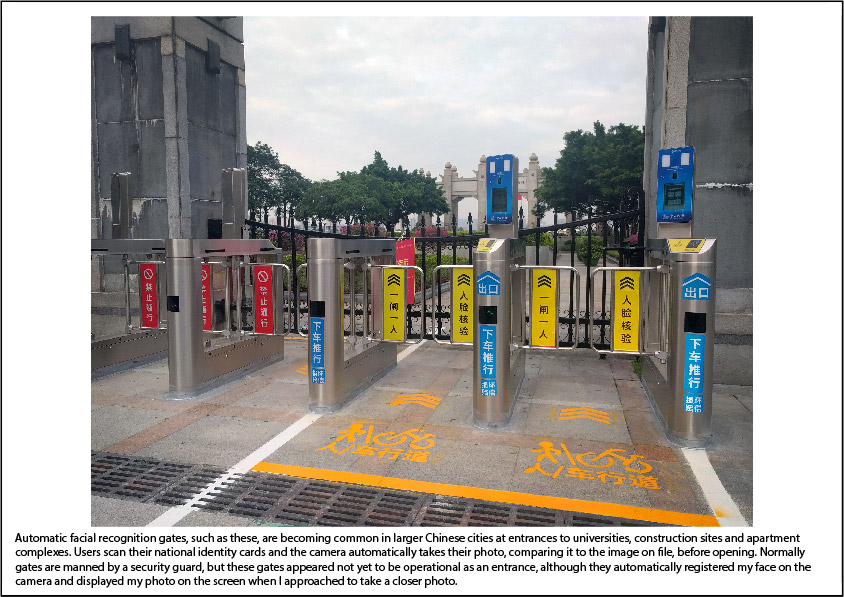 are popping up at universities, businesses and apartment complexes[7].
I do wonder, if I had an opportunity to return to the town today, would people still be so excited about the potential of technology and where their country was going in general? It's hard to know and it's getting harder and harder to conduct academic research in China.
However, despite these changes, the contributions of this project to understanding the impact of information and communication technologies in rural China remain unchanged. The town featured in this website was one of nine different field sites included in University College London's Why We Post project that investigated social media and social life across the globe. The main contribution of the project was to demonstrate how profoundly social media use is shaped by context and culture, and that is exactly what this website explores, through asking how people approach technologies; how these technologies fit into social practice and physical space; and how photography is used as a form of social communication. Despite rapid political social and technological changes in China, the underlying approach to information and communication technologies, and the landscapes of social practice, physical space and social communication are tied profoundly to the context and culture of a place, and are slow to change. It is for this reason that despite the years between fieldwork and publication, this website-based research project is believed to offer a valuable learning resources for anyone wishing to explore, understand and reflect on how ICTs are impacting life in rural China.
A number of questions remain for further research and thought, and I hope that you will leave your answers using the comment functionality on this page. Firstly, how have the impact of ICTs in rural China changed since this project was conceived and how will they change in the future? Secondly, how well can the findings of this project help people understand the impacts of ICTs on other rural societies, including those beyond China? Did you, as a viewer, see anything here that really connected with your own culture and context? And, lastly, how well has the format and the presentation materials on this site actually deepened your understanding and facilitated a process of reflection, either in relation to ICTs in rural China or ICTs on your own life, or even both? As the author of this website, we have seen this project through the long process of creation and publication and it is up to you, now, to take it from here.