
Comment: How do people approach ICTs?
 New communication technologies from fax machines, to television, to cell phones are often seen as revolutionary and potentially undermining established forms of social connection[1]; however, through the process of domestication these new technologies are adapted into people's daily lives and daily life changes to adapt to the technology. In an in-depth study of how one Chinese family in rural south-western China adopted the Internet into their home, Tom McDonald concluded that this idea of domestication was the most appropriate theoretical framework for understanding Internet adoption because it takes into account how attitudes and practices change over time, noting that the desire to reconfigure familial relationships was the driving force behind the domestication process[2]. This theoretical perspective is particularly important because it pays attention to the social context into which ICTs are introduced and the interplay between context and ICTs, in a way that prioritizes the agency and individual choices of technology users. An important question, therefore, in this study of ICTs in rural China, is how technologies fit into and interact with established forms of social practice.
At the turn of the millennium less than 2% of Chinese individuals had access to the Internet (compared with more than 40% of those in the U.S.) and most of the Chinese individuals who used this technology were from a specific population of early adopters (younger, more affluent, urbanized, educated males). At the time, home broadband subscriptions were rare and individuals connected at Internet cafés[3]. In 2002, a fire at an illegal Internet café in Beijing killed 24 young men and sparked off a moral panic about the deleterious effects of Internet use on Chinese moral culture and the problems of Internet addiction[4].
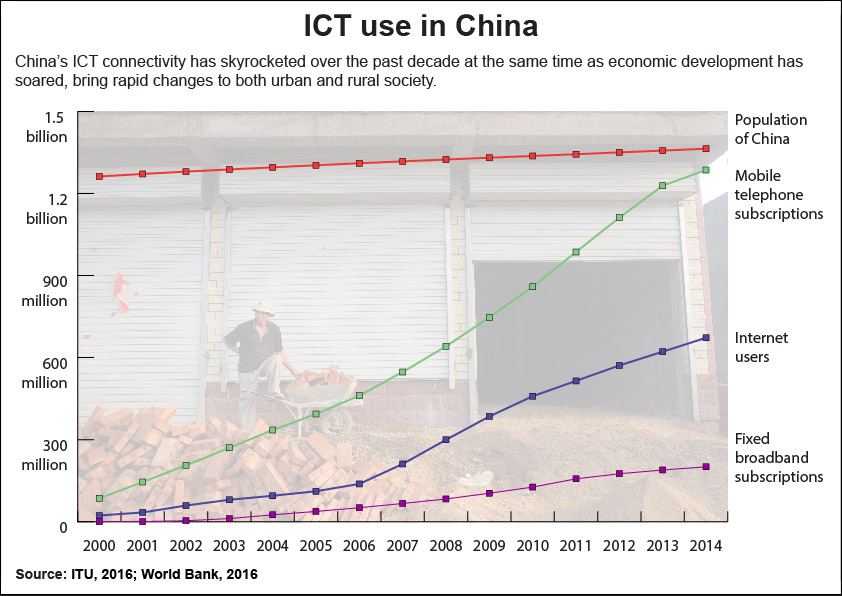 Fifteen years later, however, the Internet is well under way to being domesticated across China, with almost 50% of the population having access to the Internet in 2014 (with this figure much higher in urban areas)[5]. However, many concerns remain about how this rapid rise in Internet connectivity will affect social life in China. One area of concern is the potential for rumours and false information to be disseminated on the Internet and the opportunities the technology affords for criminal activity.
However, much of the work on the adoption of the Internet in China has focused on issues of democratization, politics and society[6] rather than how these technologies interact with the everyday lives of individuals. Research in Western contexts has examined issues such as how these technologies are incorporated into family routines, their effects on social networks or how the devices are used to signal status. However, comparatively little research has investigated these issues in China, particularly in rural settings, which is why it is important to consider how these technologies fit into the existing social practices of individual Internet users.